9 Best ContactMonkey Alternatives for 2026

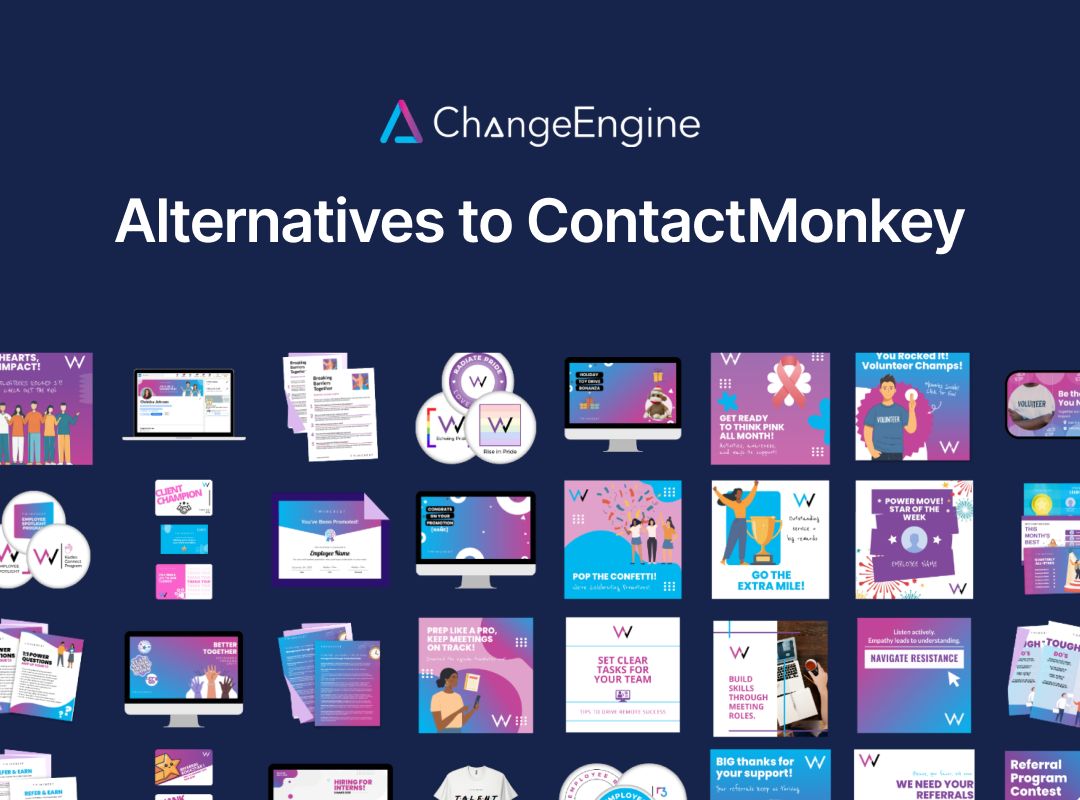
The strongest ContactMonkey alternatives in 2026 are ChangeEngine for HR and comms teams that need one message to land as email, Slack, Teams, SMS and print, Staffbase for enterprise omnichannel comms with an employee app, and Workshop for small teams that only want a better internal email tool. ContactMonkey does internal email inside Outlook and Gmail well. Most teams start looking at alternatives when email stops being the only channel they need to reach.
ContactMonkey has a real strength: it lives inside Outlook and Gmail, so comms managers can build a branded newsletter without leaving the client they already work in. That works until half your workforce doesn't have an inbox they check, or your CHRO asks what internal comms actually changed last quarter.
This guide compares nine platforms internal comms, People and employee experience teams evaluate against ContactMonkey. Each entry covers who it suits, what it does well, where it falls short and how it's priced, so you can shortlist in an afternoon rather than sitting through nine demos.
Why do internal comms teams look for a ContactMonkey alternative?
ContactMonkey is an internal email platform for Outlook and Gmail, with a drag-and-drop builder, a template library of 600+ designs and analytics on opens, clicks and read time. Teams outgrow it for structural reasons, not because the product is weak.
Five patterns come up repeatedly in evaluations:
- Deskless and frontline staff never see the email. Retail associates, nurses, drivers and technicians work from a phone or a break room wall. A single-channel email tool cannot reach them, so comms teams end up running a second, manual process for the people who need the message most.
- One message has to become five formats. The same benefits enrollment update needs to go out as an email, a Slack post, a Teams message, an SMS and a printable poster. Rebuilding it five times in five tools is where comms teams lose their week.
- Lifecycle programs need triggers, not calendar reminders. Onboarding, promotions, work anniversaries and offboarding all fire off HRIS events. If the platform can't read Workday, ADP or BambooHR, someone is building the send list by hand every Monday.
- The measurement stops at the email. Open and click rates on one channel don't answer the question a People leader gets asked in a board meeting: did the program land, and with which teams, locations and tenure bands?
- Pricing is quote-based and scales with headcount. ContactMonkey does not publish list pricing, and reviewers commonly note that costs climb as comms programs expand across a larger workforce. Worth modelling year three, not just year one.
If none of those apply to you, ContactMonkey is a reasonable place to stay. If two or more do, the platforms below are the ones worth a call.
The 9 best ContactMonkey alternatives at a glance
The 9 best ContactMonkey alternatives: our top picks
1. ChangeEngine: best for HR and comms teams running lifecycle programs across every channel
Why we picked it: ChangeEngine treats internal comms the way marketing teams treat customer campaigns. One message becomes a branded email, a Slack and Teams post, an SMS and a printable poster, and the whole thing fires automatically off an HRIS event rather than a reminder in someone's calendar. That closes the two gaps ContactMonkey leaves open: reach beyond the inbox, and programs that run without manual sends.
Best for: Organizations of 500 to 10,000 employees with a distributed, multi-site or frontline workforce, where a named People, Internal Comms or Employee Experience leader owns engagement targets.
Key features: Multi-channel comms orchestration across email, Slack, Teams, SharePoint and SMS with no new app for employees to log into. HRIS-triggered lifecycle automation built on Workday, ADP, BambooHR and Active Directory events. An AI content studio with 5,000+ templates that keeps output on brand. Engagement analytics sliced by department, region, job level or tenure, exportable for board decks and QBRs.
Results customers report: save around 20 hours per new hire, 5x faster program adoption, and roughly 60% less onboarding admin.
Watch out for: Below 500 employees there usually isn't enough comms complexity to justify the platform. And if what you actually want is a searchable document hub, that's an intranet purchase, not this one.
Pricing: Quote-based, with entry-level packages that start at content creation before the full platform. Most teams are live in under two weeks.
Compliance: ISO 27001, SOC 2, GDPR, SSO via SAML or OAuth, optional 2FA, and US, EU or Canadian data residency.
2. Staffbase: best for enterprise omnichannel comms with an employee app
Why we picked it: Staffbase started life as Bananatag, an email measurement tool, and has since built out into a full comms suite spanning email, intranet, an employee app, push notifications and digital signage. For a large enterprise that wants one vendor across every channel, it's the most complete option on this list.
Best for: Enterprises above 5,000 employees with an internal comms function large enough to run an app rollout.
Watch out for: Email is now one product inside a wider suite rather than the main event, so email-specific feature velocity is slower than a dedicated email tool. Renewal pricing is a common complaint, so agree year two and three at signature.
Pricing: Quote-based, enterprise tier.
3. Poppulo: best for large enterprises that also run digital signage
Why we picked it: Poppulo combines internal email, mobile comms and digital signage under one roof after absorbing Four Winds Interactive, which makes it unusual in this category. If you have screens in lobbies, factory floors or hospital corridors and want them fed from the same platform as your email, Poppulo is the obvious candidate.
Best for: Enterprise comms teams with physical spaces to fill and a budget line to match.
Watch out for: Reviewers regularly flag the email builder as slow to work with and note that some analytics sit behind higher tiers. It's an enterprise purchase with enterprise overhead, which is a poor fit for a two-person comms team.
Pricing: Quote-based, enterprise tier.
4. Workvivo: best for building an internal community feed
Why we picked it: Workvivo, now part of Zoom, is built around a social activity feed. Employees post, comment and react, and comms sits inside that stream rather than arriving as a broadcast. Adoption tends to be strong in organizations with an existing culture of internal sharing.
Best for: Companies that want employee-generated content and peer visibility, not just top-down announcements.
Watch out for: A feed rewards the people who already engage. If your problem is reaching the frontline shift worker who has never logged in, a feed does not solve it. Lifecycle automation off HRIS data is also limited compared to a purpose-built automation platform.
Pricing: Quote-based.
5. Simpplr: best for replacing a dead intranet without a two-year project
Why we picked it: Simpplr is an AI-assisted intranet and employee experience platform that gets stood up considerably faster than legacy SharePoint builds. Search, content management and comms sit together, and it integrates with Slack and Teams so content surfaces where people already work.
Best for: Organizations whose real problem is an abandoned intranet, and who need a content home before they need campaign automation.
Watch out for: It's still an intranet at heart, which means it depends on employees choosing to visit. If your comms measurement gap is the reason you're switching, check how far the analytics go before you commit.
Pricing: Quote-based.
6. Connecteam: best for small deskless teams that need scheduling and comms together
Why we picked it: Connecteam bundles chat, announcements, scheduling, time tracking and training into one mobile app built for people who don't sit at a desk. For a 40-person cleaning company or a restaurant group, it does a lot for very little money, and the pricing is actually published.
Best for: Small to mid-sized frontline operations under about 500 employees where operations and comms are the same job.
Watch out for: Pricing is per hub, so Operations plus Communications plus HR means three subscriptions. It's an operations app first, so brand-led content creation and HRIS-triggered lifecycle programs are thin. Larger, hybrid organizations tend to outgrow it.
Pricing: Free for up to 10 users. Paid hubs start around $29 per month billed annually for the first 30 users, with per-user charges above that.
7. HubEngage: best for multi-channel engagement with recognition included
Why we picked it: HubEngage covers email, an employee app, SMS, digital signage and intranet content, with recognition and rewards built in rather than bolted on. For teams who want engagement and recognition on one invoice, it consolidates two line items.
Best for: Mid-market organizations who want recognition and comms from the same vendor.
Watch out for: Breadth comes at the cost of depth in content creation and lifecycle automation. If your main need is turning one message into five polished formats automatically, check that workflow closely in the demo.
Pricing: Quote-based.
8. Workshop: best for small comms teams who just want better internal email
Why we picked it: Workshop is a clean, well-designed internal email tool. The builder is pleasant to use, the templates look good, and it distributes to Slack and Teams. For a one-person comms function that wants to stop wrestling with Outlook, it's a fast win.
Best for: Teams of one or two comms people whose channel mix genuinely is email plus a bit of Slack.
Watch out for: It is a like-for-like swap rather than a step up. If you're leaving ContactMonkey because email alone isn't enough, Workshop is unlikely to be the answer. Analytics and segmentation depth are lighter than the enterprise options here.
Pricing: Quote-based.
9. PoliteMail: best for Microsoft 365 shops focused on email measurement
Why we picked it: PoliteMail was one of the first internal email measurement tools and it still has a loyal base in Microsoft-heavy, highly regulated organizations. Its Reach, Attention, Readership and Engagement framework is a genuinely good way to think about internal email performance.
Best for: Microsoft 365 organizations where email is the only sanctioned channel and measurement is the whole requirement.
Watch out for: The architecture is older than the rest of this list, users report Outlook stability issues, and the email editor produces dated-looking layouts. There is no channel beyond email, so it narrows your options rather than widening them.
Pricing: Quote-based.
What should you look for in a ContactMonkey alternative?
The right ContactMonkey alternative is the one that matches your workforce shape, not the one with the longest feature list. Five questions separate a good shortlist from a bad one.
- Where do your people actually read things? Count the share of your workforce without a monitored work inbox. If it's above 20%, any email-only tool is a partial fix at best.
- Does it build once and publish everywhere? Ask the vendor to take one message and produce the email, the Slack post, the SMS and the poster in the demo. Watch how many times they retype the copy.
- Does it read your HRIS? Named integrations with Workday, ADP, BambooHR or Active Directory decide whether onboarding and milestone programs run themselves or land on your to-do list.
- Can you segment the reporting the way your CHRO asks questions? Department, location, job level and tenure. If the analytics only report at company level, you cannot prove a program worked.
- Will IT and Security clear it in weeks, not quarters? ISO 27001, SOC 2, GDPR, SSO and documented data residency. Ask for the certificates up front and you remove the longest delay in the process.
How we chose these ContactMonkey alternatives
We built this list around the platforms internal comms and People teams actually put on shortlists next to ContactMonkey, drawn from competitive evaluations, review-site comparison data and buyer conversations. Each platform was assessed on five criteria: channel coverage beyond email, depth of HRIS integration, content creation and templating, analytics granularity, and realistic fit by company size.
Platforms are ordered by fit for the buyer this guide is written for: a People, Internal Comms or Employee Experience leader in an organization of 500 to 10,000 employees with a distributed or frontline workforce. A tool that suits a 60-person startup is ranked lower here even where it's excellent at that size, and we've said so in each entry. ChangeEngine publishes this comparison, and we've been explicit about where we're not the right choice.
FAQs: ContactMonkey alternatives
Q: What is the best ContactMonkey alternative? A: It depends on channel mix. ChangeEngine suits HR and comms teams who need one message delivered as email, Slack, Teams, SMS and print with HRIS-triggered automation. Staffbase suits enterprises wanting an employee app. Workshop suits small teams who only need better internal email.
Q: Is there a free ContactMonkey alternative? A: Connecteam offers a free plan covering up to 10 users with access to its core features, which makes it the only genuinely free option on this list. Every other platform here, including ContactMonkey itself, is quote-based with pricing that scales by employee count and module selection.
Q: Does ContactMonkey work for frontline and deskless employees? A: Only partially. ContactMonkey delivers inside Outlook and Gmail and offers employee SMS, so it reaches frontline staff who have a work email address or a phone number on file. It has no employee app, digital signage or print output, which is how most deskless workforces are actually reached.
Q: How does ChangeEngine compare to ContactMonkey? A: ContactMonkey measures internal email inside your existing email client. ChangeEngine automates whole employee programs across email, Slack, Teams, SharePoint, SMS and print, triggered off HRIS events, with analytics segmented by department, region and tenure. ContactMonkey is an email tool. ChangeEngine is marketing automation for HR.
Q: How long does it take to switch from ContactMonkey? A: With ChangeEngine, most teams send their first multi-channel message within about five business days and have the full platform live in under two weeks, including HRIS integration. Content can be built from day one using the template library and AI content studio.
Q: Do these platforms replace an intranet? A: Simpplr, Staffbase and Workvivo include intranet or content-hub functionality. ChangeEngine, ContactMonkey, Workshop and PoliteMail do not, and are not trying to. If your goal is a searchable policy library, buy an intranet. If your goal is getting messages read and programs delivered, buy a comms platform.
About ChangeEngine
ChangeEngine is marketing automation for HR and People teams. It turns one message into a branded email, a Slack or Teams post, an SMS and a printable poster, triggered automatically off HRIS events from Workday, ADP, BambooHR and Active Directory, with engagement analytics segmented by department, region, job level and tenure. Certified to ISO 27001 and SOC 2, GDPR-compliant, with SSO and US, EU or Canadian data residency. See how internal comms software for HR teams works, or book a demo.