The Best Internal Comms Platforms

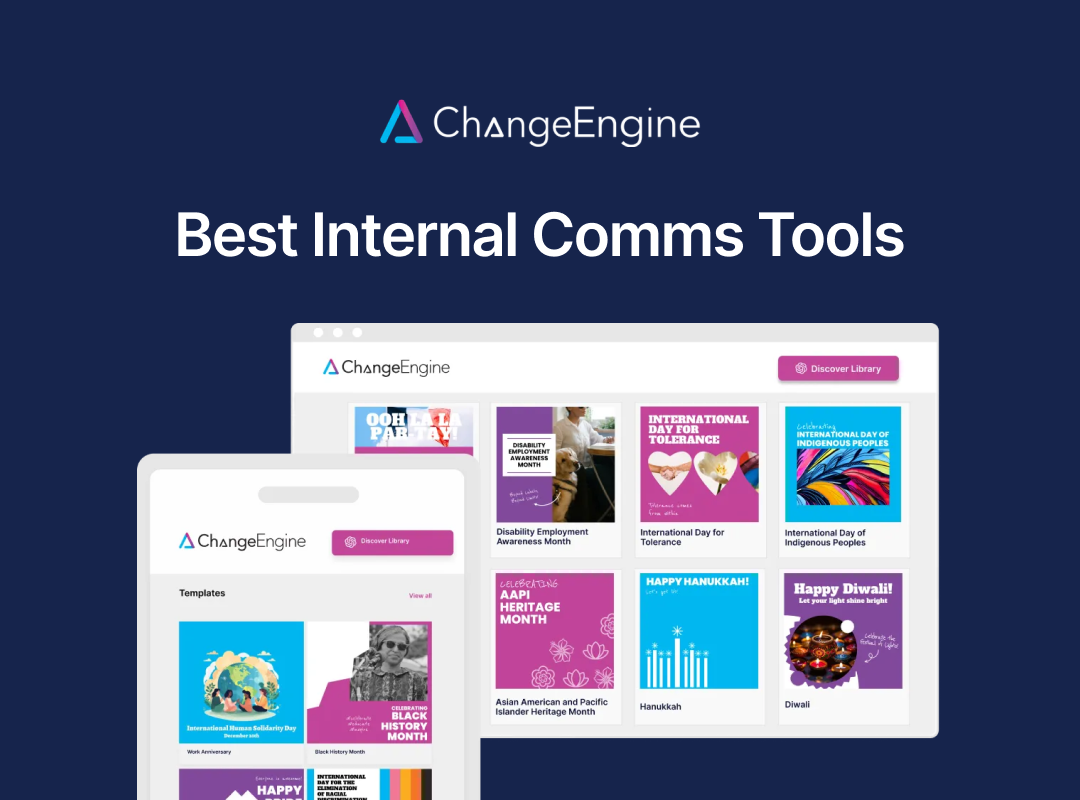
The best internal communication tools for 2026 are ChangeEngine for People and comms teams who have to produce branded communications without a designer, Staffbase for enterprises that want email, intranet, an employee app and digital signage on one contract, and Simpplr for organizations whose real requirement is a modern intranet. The right pick depends less on feature count than on whether your problem is creating communications or distributing them.
Most internal comms shortlists get built the wrong way round. Teams line up feature grids, pick whichever platform ticks the most boxes, then find out eighteen months later that the tool assumed a content function they never had.
The nine internal communication tools below are grouped by the problem each one actually solves. Some distribute messages to people who already log in. Some produce the messages in the first place. A few are built for enterprise scale and carry the implementation weight that comes with it. Each entry names who it fits, where it disappoints, and how it is priced.
The 9 best internal communication tools at a glance
This list is ordered by use case, not by rank. Three of the nine beat ChangeEngine outright for specific enterprise requirements, and we say so below.
The 9 best internal communication tools: our picks
1. ChangeEngine: best for teams producing branded comms without design headcount
Why we picked it: Most comms platforms assume you arrive with finished content and need somewhere to send it. That assumption breaks for the People team of two running comms for 3,000 employees, because the bottleneck is not distribution. It is producing a benefits email, a poster for the warehouse floor, a Slack post and an SMS that all look like they came from the same company.
ChangeEngine creates the communications rather than only sending them. One message becomes a branded email, a Teams or Slack post, a printable poster and a text, built from a library of 5,000+ templates and kept on-brand automatically. Programs run off HRIS events through the Employee Journey Builder, so onboarding, anniversaries and promotions fire without anyone remembering to send them.
Best for: People, HR and internal comms teams at 500 to 10,000 employees who own communications but have no designer, no copywriter and no marketing support.
Key features: AI Content Creation Studio for multi-format branded content, Workforce Communication Orchestrator for scheduling across email, Slack, Teams and SMS, and Engagement Analytics reporting open, click and action rates by team and location.
Watch out for: ChangeEngine is not an intranet. There is no document repository, no wiki and no company directory, so if your project is genuinely "replace SharePoint as the place things live", Simpplr or Unily fit better. It also does not do digital signage natively, which matters if you have screens in lobbies or on factory floors.
Pricing: Quote-based, with entry packages for smaller comms teams. Book a demo to get a figure.
2. Staffbase: best for enterprises wanting one contract across every channel
Why we picked it: Staffbase runs email, an intranet, a mobile employee app, push notifications and digital signage from a single system across 75+ languages, for roughly 2,000 customers. Very few vendors cover that much ground on one contract, and for a global enterprise consolidating five tools into one, that breadth is the whole argument.
Best for: Enterprises above 5,000 employees with a dedicated internal comms function and the appetite for an app rollout.
Watch out for: The employee app only works if people install it, and getting a distributed workforce to download, register and keep an app is months of internal campaigning. Reviewers also skew enterprise, and mid-market teams frequently report carrying enterprise implementation weight without enterprise admin capacity. If that is the risk you are weighing, the Staffbase alternatives comparison covers it in more detail.
Pricing: Quote-based, enterprise.
3. Poppulo: best for enterprises running digital signage alongside comms
Why we picked it: Poppulo has 4,500+ customers and a Fortune 100 client base, and it is one of very few platforms that runs internal email, mobile comms and digital signage from one system. If you have screens in hospital corridors, factory floors or retail back rooms, that single-system argument is real.
Best for: Enterprise comms teams with physical spaces to fill and staff to operate the platform.
Watch out for: Advanced campaigns carry a genuine learning curve, reviewers describe the email builder as rigid, and pricing is opaque and grows module by module. The signage capability is dead weight if you have no screens. Our Poppulo alternatives guide covers the lighter options.
Pricing: Quote-based, enterprise.
4. Firstup: best for very large enterprises with complex orchestration
Why we picked it: Firstup is built for organizations where audience targeting is a discipline in itself: tens of thousands of employees, dozens of business units, and campaigns that need to reach precise slices of the workforce in the right sequence. The orchestration and segmentation depth goes well beyond what mid-market platforms attempt.
Best for: Enterprises above 10,000 employees with a comms operations team.
Watch out for: The platform assumes people to run it. Below roughly 10,000 employees, most teams pay for orchestration depth they never use, and implementation timelines reflect the complexity.
Pricing: Quote-based, enterprise.
5. Simpplr: best for organizations that need a modern intranet first
Why we picked it: Simpplr is an AI-assisted employee experience platform built on a modern intranet, with search across connected business systems, a newsfeed, surveys and recognition. It launches faster than a SharePoint rebuild and it looks considerably better.
Best for: Organizations where the actual problem is that information is scattered and nobody can find anything. G2 reviewer data puts Simpplr at roughly 57% mid-market and 40% enterprise, so it spans both.
Watch out for: An intranet only reaches employees who visit it. If half your workforce has never logged in, a better hub does not fix the reach problem. See the Simpplr alternatives comparison for the push-versus-pull trade-off.
Pricing: Quote-based.
6. Workvivo: best for building an internal community feed
Why we picked it: Workvivo, owned by Zoom, does social and peer recognition better than anything else on this list. The feed feels familiar, adoption among people who do log in is strong, and culture-led organizations get real value from it.
Best for: Companies whose goal is connection and community rather than guaranteed message delivery.
Watch out for: A feed is opt-in by design. Critical messages compete with birthday posts, and there is no guarantee a policy update reaches the people who need it. Teams that hit that wall tend to look at the options in our Workvivo alternatives guide.
Pricing: Quote-based.
7. Unily: best for enterprises needing deep design control
Why we picked it: Unily gives enterprise teams more control over the look and structure of the digital workplace than any other platform here. For brands where the internal experience has to match the external one precisely, that flexibility is worth paying for.
Best for: Large enterprises with in-house design and IT resource to use the flexibility.
Watch out for: Flexibility costs time. Unily projects are builds rather than rollouts, and the platform rewards teams who can staff them.
Pricing: Quote-based, enterprise.
8. ContactMonkey: best for teams where internal email is the priority channel
Why we picked it: ContactMonkey works inside Outlook and Gmail, so there is no new system for anyone to learn. Comms teams get a drag-and-drop email builder, audience segmentation and open and click tracking on messages they were already sending.
Best for: Organizations where email genuinely reaches everyone and the gap is measurement, not reach.
Watch out for: It is a single channel. Frontline and deskless employees without company email addresses are outside its reach entirely, and there is no poster, SMS or signage output.
Pricing: Quote-based.
9. Microsoft Viva Engage and SharePoint: best for Microsoft 365 committed organizations
Why we picked it: For most enterprises this is the honest baseline, because it is already paid for. SharePoint handles documents and pages, Viva Engage handles the social layer, and Teams handles conversation. Plenty of organizations run internal comms on this stack without buying anything else.
Best for: Organizations with in-house SharePoint capability and a workforce that lives in Microsoft 365 all day.
Watch out for: SharePoint adoption is the recurring failure point, and building anything branded takes design and development time most People teams do not have. It also offers nothing for employees without a Microsoft licence, which usually means the frontline. Our guide to legacy intranets covers when this stack stops being enough.
Pricing: Included in Microsoft 365 licensing.
What changes when you are buying for more than 5,000 employees?
Above roughly 5,000 employees, the evaluation stops being about features and starts being about procurement, security and workforce shape. Five things change.
Security review becomes a gate, not a checkbox. IT and Security will ask for certifications before the comms team gets to argue product fit. ISO 27001, SOC 2 and GDPR compliance, SSO via SAML or OAuth, optional 2FA and encryption in transit and at rest are the baseline. Data residency matters too, and ChangeEngine offers US, EU and Canadian options. Surface the certifications early. You can point the security team at the Trust Center rather than filling in a questionnaire from scratch.
HRIS integration stops being optional. At this size, manually maintained distribution lists break within a quarter. The platform has to read from Workday, ADP, BambooHR or Active Directory so audiences update themselves when people join, move or leave. ChangeEngine connects to 75+ systems, and the integrations list is worth checking against your stack before the first demo.
Multi-entity and post-acquisition structures get complicated. Enterprises rarely run one HRIS. After an acquisition you often have two or three, plus separate brands, separate policies and separate comms calendars. Ask every vendor directly how they handle multiple source systems and brand sets in one instance, because most will need a call to answer it. Our mergers and acquisitions resources cover the comms side of that work.
The deskless share decides the channel mix. A 12,000-person organization with 8,000 frontline employees has a fundamentally different problem to a 12,000-person software company. If a large share of your workforce has no company email and no desk, an email tool and an intranet will both miss them. That is a channel question, not a feature question, and it is covered in more depth in our guide to frontline communication tools.
Production capacity becomes the real constraint. This is the one most enterprise buyers underestimate. Buying a platform that distributes to 10,000 people does nothing about who designs the benefits campaign, writes the change-management sequence and builds the posters. Enterprise comms teams are frequently no bigger than mid-market ones. If yours is three people supporting 8,000 employees, the tool that creates communications will save more hours than the tool that sends them faster.
Be honest about where you sit. If you need an employee app, digital signage and orchestration across dozens of business units, Staffbase, Poppulo and Firstup are built for that and ChangeEngine is not. If the constraint is that your team cannot produce enough good content to fill any of those platforms, that is the problem worth solving first.
How do you choose between an intranet, an email tool and a comms platform?
The three categories solve different problems, and mixing them up is the most common shortlisting mistake.
An intranet is pull. Employees come to it. Simpplr, Unily and SharePoint are where information lives, which works for policies, handbooks and anything people go looking for. It fails for anything time-sensitive that people need to see whether or not they thought to check.
An email tool is push, on one channel. ContactMonkey and similar tools get a message into an inbox and tell you who opened it. That works when everyone has a company email address and reads it.
A comms platform is push, across channels, with production attached. ChangeEngine, Staffbase, Poppulo and Firstup send the same message to email, chat, mobile and, in some cases, screens, and report on what landed.
Start from the failure you are trying to fix. If people cannot find information, you need an intranet. If messages get sent but not opened, you need measurement. If your team cannot produce the communications in the first place, no distribution tool will help. Once you have picked, our internal comms rollout playbook covers getting it adopted.
How we chose these internal communication tools
We built this list around four criteria rather than feature counts.
- Reach across a distributed workforce. Whether the tool can get a message to employees without company email, without a desk and without an app install.
- Production capability. Whether the platform creates communications or only distributes content you arrive with.
- Measurement. Whether you can report opens, clicks and actions by team, location and segment, rather than a single sitewide number.
- Implementation weight relative to team size. Whether the platform assumes a comms operations function that most People teams do not have.
Shift-scheduling and frontline-only apps such as Connecteam, Blink and Beekeeper are covered separately in our frontline communication tools guide, because they solve a different problem to the platforms here. Survey and engagement-measurement vendors are also out of scope.
FAQs
What is the best internal communication tool for a large company?
For enterprises above 5,000 employees, Staffbase is the strongest all-in-one option because it runs email, intranet, an employee app and digital signage on one contract. Firstup fits organizations above 10,000 employees needing complex orchestration. ChangeEngine suits enterprise People teams whose constraint is producing branded content rather than distributing it.
What is the difference between an internal communication tool and an intranet?
An intranet is a destination employees visit to find information, such as policies and handbooks. An internal communication tool pushes messages out to employees through email, chat, mobile and SMS, whether or not they log in anywhere. Intranets fail for time-sensitive messages. Comms tools fail as document repositories.
How much do internal communication tools cost?
Most enterprise internal communication platforms are quote-based and priced on employee count, modules and channels, so published pricing is rare. Microsoft Viva Engage and SharePoint are included in Microsoft 365 licensing. ChangeEngine offers entry packages for smaller comms teams alongside quote-based enterprise pricing.
Is ChangeEngine right for an enterprise organization?
ChangeEngine fits enterprises whose People or comms team has to produce branded communications without design or marketing support, typically between 500 and 10,000 employees. It is not the right choice if you need an intranet, a document repository or digital signage, where Simpplr, Unily and Poppulo fit better.
Do internal communication tools work for frontline employees?
Only tools that reach employees without company email or a desk. SMS, printed posters and QR-linked mobile content work for frontline teams. Email-only platforms and intranets do not, because frontline employees often have no company address and no reason to log in.
About ChangeEngine
ChangeEngine is employee communication software that creates the communications, not just sends them. People, HR and internal comms teams use it to turn one message into a branded email, a Slack or Teams post, a poster and an SMS, triggered automatically off HRIS events and measured by team and location. It integrates with 75+ systems including Workday, ADP and BambooHR, and holds ISO 27001, SOC 2 and GDPR compliance. See how internal comms teams use it.